Shout out to the local MLOps community in Toronto who will be holding their first meetup tonight and the Oslo crew holding their first meetup tomorrow! We now have 26 cities holding local events 🥳
Coffee Session Trustworthy Machine Learning
Kush Varshney, a research scientist at IBM research working on trustworthy AI, hashed some of the incubating tension on the delicate topic of trustworthiness in AI.
Trustworthy AI The first thing to have in mind about the topic is, what would make something or someone worthy of your trust?
For humans, it could be their track record. But for AI systems, it's quite tricky to anticipate their behavior because of their emergent nature. However, it doesn't mean it's impossible to trust them, at least to some degree -- even if they are very young to take over the world someday......
Truth is, trust is mostly a feeling that comes from a reasonable level of understanding of the trustee's capacity and not necessarily a total understanding.
We can apply them when creating trustworthiness when modeling AI systems.
Adopting Trustworthy ML Empirical and theoretical work is being done around understanding assumptions of the existence of a trade-off between standard metrics like accuracy and the different dimensions of trustworthy metrics like fairness bias, adversarial robustness, explainability, and
privacy.
As an ML practitioner, optimizing for trustworthy metrics relevant to your business solution is the best starting point. Having conversations with policymakers, CEO, compliance folks, e.t.c. to understand the business's moral compass(values), working in that direction, and focusing on using those values to influence the trustworthiness in the ML system that is powering the business would be a good path to take.
Q (Shri Javadekar): What are some of the MLOps tools that aren't widely used today
but will soon become famous? (especially open-source)?
A (Goku Mohandas): Without naming specific names, MLOps tools that are working VERY closely with the data stacks are heavily positioned for adoption and success. These data stacks are already so mature but are progressing at a much faster rate than ML (and makes sense given upstream) so the tools that are piggybacking off of this thought and development maturity are set. There are even
modeling-based ones that are approaching their abstractions in this manner (and recently a guest on the podcast)!
Q (Richard Puckett) How would you recommend specifically pitching ML-based companies to investors? Is the pitch
structured differently? Should one look for specific types of investors related to ML?
A (Goku Mohandas): You have to show how you fit with the current workflows in the industry. Your early-stage tool most likely won't satisfy all workflows across maturity levels/stacks, so prove your fit in the niche you're after and prove that it's a big enough market and why you're set for traction there.
This is blog is based on the MLEs project for the MLOps Community to fully understand what different people touching ML do at their jobs. We want to find out what their day-to-day looks like.
We have Kyle Gallatin on this one, a Senior Software
Engineer, Machine Learning at Etsywith five years of experience. From the most granular to the most mundane, he tells us everything about his experience.
His current position deals with a lot of unique challenges in the ML infrastructure space. It’s a unique blend of software engineering, systems design, and ML – which means he gets to develop skills across a wide array of
disciplines.
Combined with the unique challenges of ML infrastructure and evolving best practices, it’s a space where he gets to learn and grow in a number of different dimensions.
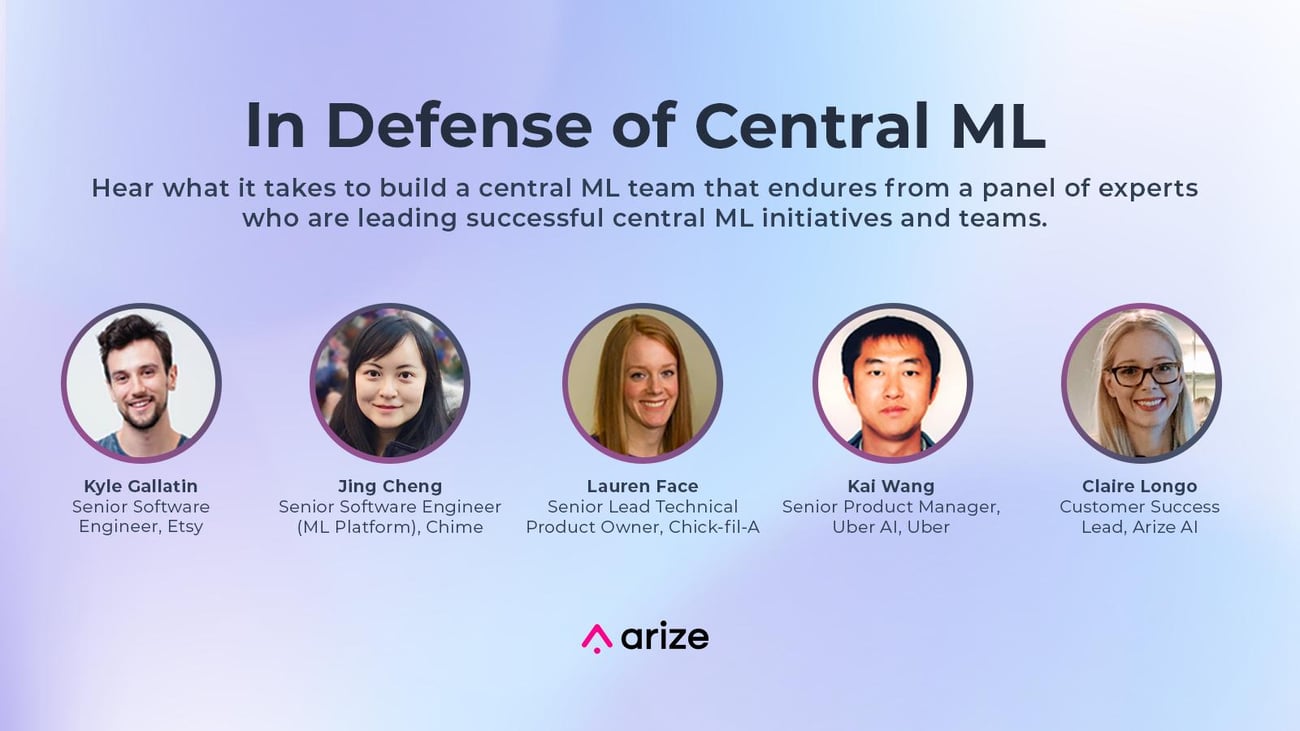
Debates on the ideal team structure for machine learning organizations are heating up. In conferences and technical communities alike, many are questioning whether having a centralized ML platform team is the right approach for their company.
Arize AI assembled a brain trust of successful central ML leaders to share what it takes to build a
central ML team that endures. Whether your team is just getting off the ground or you already have a mature data organization, this session can help you optimize your ML practice. Learn more in this action-packed session featuring Chick-fil-A, Chime, Etsy, and Uber AI!
Using a semi-realistic business (a hypothetical traveling circus) as the case study, this blog gives a practical understanding of building a data model from scratch. Building a data model is no easy task no
matter the data domain or scale. It involves much more than just a series of technical decisions and prototyping.
Steps involved:
Talking to stakeholders about what they hope to accomplish by having a unified data model.
Company subject matter experts (SMEs) in the data domain.
How that domain might be unique to the particular business.
Any people involved with
collecting the raw data sources.
Any peculiarities in the data itself must be accounted for.
Building a data model can take a while and requires patient studying of the data and conversations with various internal groups. There needs to be quite a bit of prerequisite understanding of the data sources available and how they link together conceptually before you could generate a logical model.
Thanks for reading. This issue was written by Nwoke Tochukwu and edited by Demetrios Brinkmann and Jessica Rudd. See you in Slack, Youtube, and podcast land. Oh yeah, and we are also on Twitter if you like chirping birds.