Reminder we are doing an Engineering Labs (hackathon) with Redis and Saturn Cloud around Vector Search. I made a song about it too, because... of course, I did. Sign up for it here. It starts next week!
P.S. the Creative AI meetup we had last week got pushed to this week. So you can still join us.
P.P.S there is an AMA session with the creator of Uber's Michelangelo platform and the creator of Feast on Thursday
Past Meetup Build AI Trust
In this meetup, we had Danny Brock, a Solutions Engineer at fiddler, give insights on how fiddler is used for driving the fundamental mission of building trust in AI.
Fiddler centralizes the function of model performance management. It can integrate with whatever existing ML stack you set up and enables on-prem and public cloud deployment on fiddler cloud.
In technical terms, performance management is the act of monitoring behavior.
Fiddler adds an extra level of robustness to performance management by layering explainability, fairness, and analytics as its four key pillars. This approach helps to identify the
root cause of model performance degradation.
Building Trust A recent study by PwC predicts a potential contribution of $15.7 TR from ML/AI to the global economy by 2030. This shows that ML/AI is becoming a critical part of modern business.
The interest in implementing the model performance isn't the sole worry of a data scientist. Other personas around the business/organization now also share this sleepless thought. They all ask the same question about this pressing issue from various perspectives:
Data scientists ask, "How does this model work?"
IT & operations ask, "How do I monitor & debug?"
Auditors & regulators ask, "Are these decisions fair?"
Customer support asks, "How do I answer this?"
Business users ask, "Can I trust our AI?"
Fiddler's approach spells out the mission behind its mantra of building this trust in AI, both inside and outside an organization.
Under the hood fiddler requires three major things to execute its agenda:
Baseline reference dataset, typically training data to help fiddler understand the expected data distribution for the model at production
Model information, which generally includes input, outputs, and the task that the model is performing
Logs from the model in production, such as event logs, inference logs e.t.c
This blog was written in partnership with Nate Mar, Founding Engineer at Arize.
Increasingly, companies are turning to natural language processing (NLP) sentiment classification to better understand and improve customer experience. From call centers to loyalty programs, these models inform important business decisions across customer touchpoints. Unfortunately, many ML teams today do not have reliable ways to monitor these models in production and stay on top of things like embedding drift. This post is designed to help them get started.
Jeffrey Luppes's primary responsibilities range from the
continuous management and development of the MLOps platform that he architects to making sure that the model in deployment is accessible, is running at an optimal cost, and can handle the workloads it receives.
Before interviewing for his current position, he thought he could focus primarily on ML Engineering. Rather, he spent his first couple of months making data science proofs of concept to prove the value of AI and ML to the business.
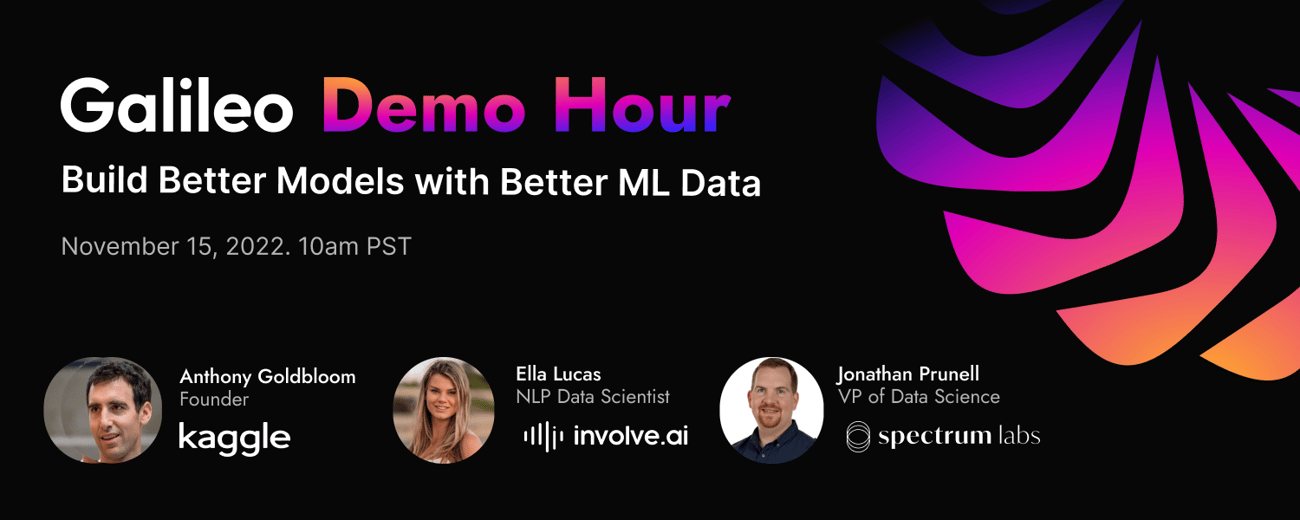
Learn how to save your team hours of gruelling data debugging. Galileo is the world’s first Machine Learning Data Intelligence platform- enabling data scientists to build better-performing ML models, faster, by finding and fixing data errors in minutes. 💫In this demo hour we will introduce you to Galileo and the data scientists who rely on Galileo in their workflow. Our Demo Hour will be a chance to:
Learn from ML leaders (such as the Founder of Kaggle) about ML Data Intelligence.
Hear from NLP practitioners on how to improve model performance.
Get hands-on experience with our free Galileo Community Edition offering.
Interact with the rapidly growing community of Galileans– data scientists and ML practitioners like you!
Thanks for reading. This issue was written by Nwoke Tochukwu and edited by Demetrios Brinkmann and Jessica Rudd. See you in Slack, Youtube, and podcast land. Oh yeah, and we are also on Twitter if you like chirping birds.