Interested in giving a talk at an MLOps Community local meetup? we are now in over 25 cities! Booom!
Fill out this form and specify the cities you’d be able to speak in. An ideal speaker is anyone who has felt the challenges of operationalizing machine learning and has something to share about their journey.
Also, we have a virtual meetup on Wednesday, November 09, at 6:00 PM, CEST/ 9am PST, be sure to pop by.
Coffee Session Riot Games AI
On this podcast, we had Ian Schweer, Snr Software Engineer at Riot Games, give us a detailed breakdown of the internal workings of games that are built at Riot Games, like league of legends.
League of legend Architecture League of Legends is a MOBA game, 10-player, 5v5 game. It has a custom game engine that is built on Java and C++ systems.
The Java shop of services helps players to log in, see the client, buy stuff, get matched with other available members, build their team and also collect end-of-game data e.t.c
The data is collected in a couple of different spaces, from doing typical DB scrapes to ingestion of audit telemetry from Kafka.
The game architecture also has a server-side authoritative design for making decisions. This causes everything in the game server to get logged out into a nice compact JSON file, that serves as a fully reference data file.
Without hitting the databases directly for data, these reference files can then be used by other systems to do player/end game-level aggregations.
After data extraction and processing. The data is then pushed either into an on-premise or remote (AWS Glue) hive data warehouse for management.
The ML Piece Data from the Warehouse is used to do the typical "series of ML decision science jobs" for business metrics, feature engineering e.t.c
The outputs from these jobs end up in one of three different locations which are dependent on the next process. This location could be the hive warehouse, an S3 bucket, or the rocks DB implemented on top of an S3 feature store.
Occasionally some of the data or models are serialized/embedded directly into the game code so that on the following patch of the game you get the next version of the model.
We had a really fun meet-up with Suyash Joshi. He gave a magical talk on making art, music, and jokes/humor with image generation models.
AI Art History Image generation models have a long history dating back to the 1960s. The
first-ever Image generation model, Aaron, was built by Harold Cohen. It was an AI system that created art.
There is a whole field called generative art that exists over the last decade. They didn't make use of neural networks/AI.
It required the artist to do more work of writing codes/logic when generating the art rather than providing a prompt in AI-based generative art.
AI Art Controversies The controversies exist from the artist's and engineer's points of view.
For one, there is the question around the attribution of the reward on an art piece that was generated by AI, to either the developers of the AI art software or the artist that used the software.
Another argument in the art community is "what should be the worth of AI art?" i.e should it be expensive/valued high or not?
There are also copywriting concerns about AI art systems.
But as the long list might
keep going, it is still a promising and useful technology.
Robert John is a Data Scientist and Machine Learning Engineer at Condo group. He loves working on end-to-end processes of a machine learning life cycle.
In this blog, he shares tips on addressing the complex issues that arise with production-level ML. These issues are a result of the various components and moving pieces that are involved with ML in production.
Yesterday marked the official close of our latest Engineering Lab centered
on Redis Vector Similarity Search (VSS) using the arXiv scholarly papers dataset. While this capability has proven itself at companies like Google, Microsoft, Facebook, and Amazon, we are bringing it to the masses.
We saw nearly 90 engineers and practitioners, forming over 20 teams from around the world, compete for cash and GPU hardware prizes. The goal: expand the envelope of semantic search and intelligent document processing applications. We gave the teams an example: a live-hosted demo app and
code. From that point forward, the possibilities were endless.
As submissions continue to pour in, we’d like to take this moment to thank each of our core sponsors that made this possible: Redis, Saturn Cloud, and NVIDIA Inception. Without their support, a platform for compute, prizes… the whole thing would have sputtered to a halt. We can’t wait to share some unique solutions created with the broader community. Though the Engineering Lab is behind us, there are still opportunities to learn more about vector similarity search. Be on the lookout for an upcoming Redis webinar on 12/15 ALL about vector similarity search and how to get started.
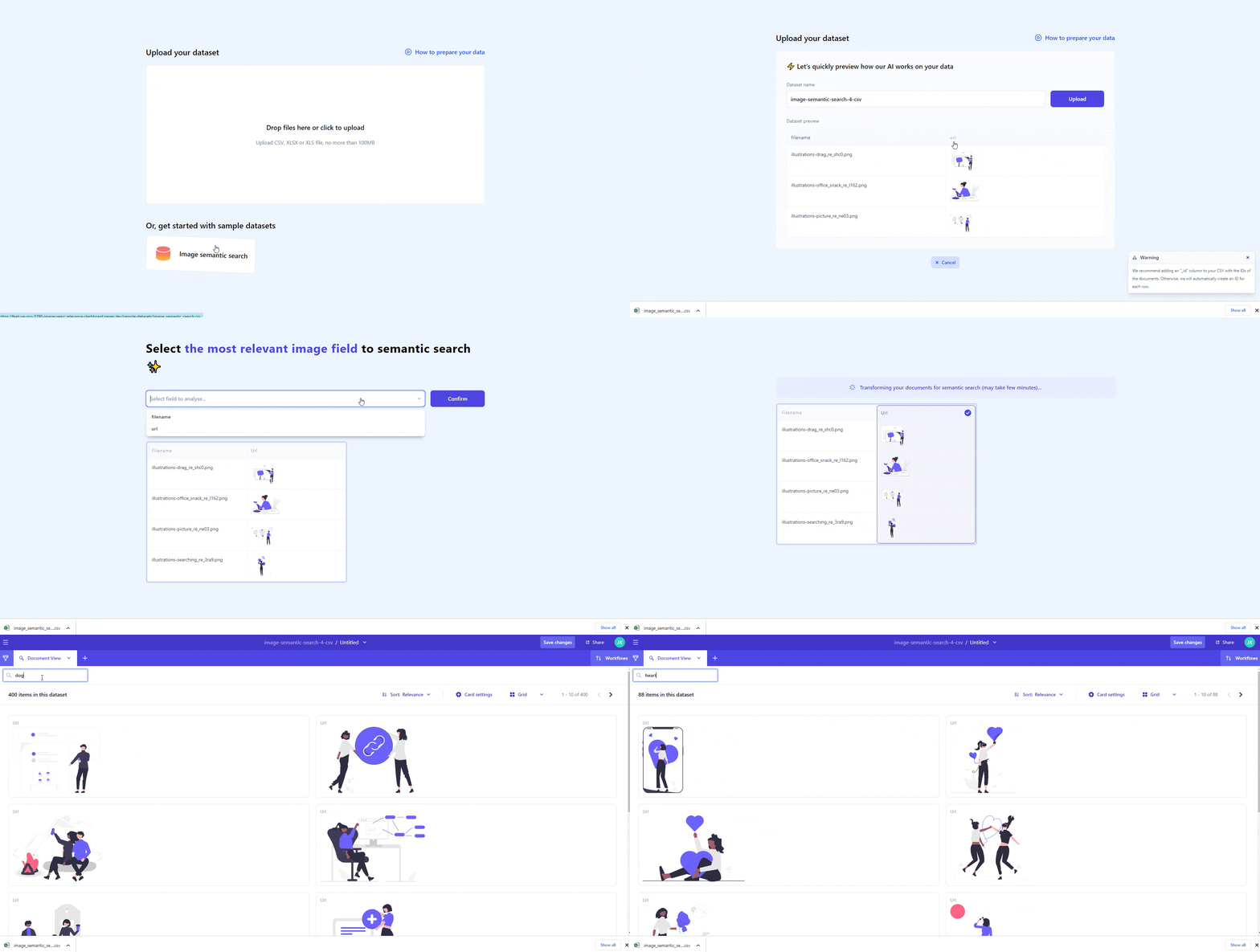
Hot off the press! Redis is pleased to share our newest commercial partnership with RelevanceAI. The focus is on democratizing access to vector search applications and use cases.
Relevance AI enables teams across an organization to process and analyze unstructured data like text and images, and it’s all powered by Redis. This is a great option to bridge the technical divide
between end-users who need the insights from vector search without needing engineers to build it out.
Thanks for reading. This issue was written by Nwoke Tochukwu and edited by Demetrios Brinkmann and Jessica Rudd. See you in Slack, Youtube, and podcast land. Oh yeah, and we are also on Twitter if you like chirping birds.