|
|
|
|
Following the positive response to the playlist in last week’s newsletter I’ve spent all week rehearsing with my band ELO (Efficient Learning Orchestration). Just had to take a breather after finishing recording Sitting on the Dock{er) the Bay (thanks for the suggestion Tom).
It’s easy to be overwhelmed with the sense of history here at A/B Road Studios, but it really gives you the freedom to experiment, which we’re taking full advantage of on our new song, Llama Chameleon.
|
|
|
|
|
Album to drop in late Spring. Tour to follow.
Even hotter than the album launch party though, will be our AI in Production event. More headliners than Glastonbury, with speakers from Netflix, Notion, Perplexity AI, Uber, Microsoft, Google, LinkedIn, Reddit, and more, all talking about how they are dealing with productionizing LLMs.
Plus, workshops that will teach you how to set up your use cases and skip over all the headaches.
And tickets are easier to get than Glastonbury too, just register here for free!
|
|
|
|
|
|
|
How Data Platforms Affect ML & AI // Jake Watson // MLOps Podcast #207
This week the podcast delivers a double dose for those dealing with day-to-day data dilemmas!
First up, I’m joined by Jake who, after reading his blogs, I knew I had to have on the podcast.
We chat about the challenges with data access and feature engineering, understanding business logic, and the role of data pipelines in ML. We also look at intelligent data platforms combining generative AI, natural language processing, and data, plus scaling airflow for ML and alternatives for
managing data pipelines.
He also shares his experience working with companies on different stages of their data journey, and the ever-present need for a balance between fast delivery and data quality.
Data platforms - done!
|
|
|
|
|
|
|
|
|
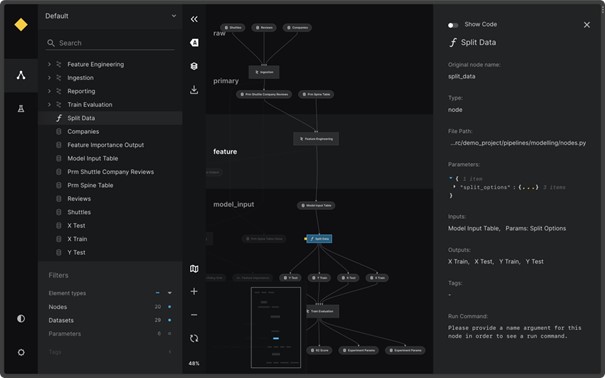
Kedro is an open-source Python toolbox that uses software engineering approaches to turn data science code into production-ready applications. It’s a growing project, with over 12 million downloads, incubated in the Linux Foundation’s AI & Data ecosystem.
Kedro’s recent 0.19 release includes a raft of new features, bug fixes, and enhancements to the documentation: you can find the details in a post at blog.kedro.org.
One of the key changes in the new release is for notebook
users.
Fundamental to good software is the rule that you should avoid hard coding values across your codebase because it can make it hard to maintain, and limits reusability. A best practice is to use configuration files to store values instead of hard coding them wherever they are used. Kedro 0.19 offers simplified access to its configuration loader, making it easy to store and retrieve constants from configuration files without a full Kedro project. While this was possible in previous releases, there was some accidental complexity due to underlying assumptions about the configuration files’ location. With Kedro 0.19, the configuration loader, based on the OmegaConf open-source library, offers greater flexibility for use with your own directory structure.
|
|
|
|
|
Kedro was created to solve the challenges faced regularly in data science projects and promote teamwork through standardized team workflows. It is part of QuantumBlack’s Horizon suite, and one of a family of open-source tools that include MLRun, Nuclio, and Vizro. Kedro and Kedro-Viz lead our offering in terms of open-source standards and usability. We are constantly refining them to facilitate uptake by the data science community: we’ve recently released a video training course, we’ve created award-winning documentation, and this recent release
makes Kedro more accessible to notebook users.
Want to learn more about Kedro 0.19? Check out the following resources, and keep an eye out for an upcoming online community update meeting.
Kedro community Slack
|
|
|
|
|
|
|
Micro Graph Transformer Powering Small Language Models // Jon Cooke // MLOps Podcast #208
Data dish two!
And, if we’re cooking up a recipe for this podcast, I’d say it’s three parts organizational and two parts technical. With a couple of dashes of Lord of the Rings in there for good measure.
We chat about the differences between startups and larger companies, product management mindset, and creating data products that align with the business needs so have buy-in from from the start.
We also talk about the use of transformer architecture to accelerate the process of defining, prototyping, and deploying data analytics, allowing the business side to ask for data insights using natural language with instant deployment of analytics through a specialized system
Plus we talk about enhancing efficiency through things like data points, a human API approach, a design pattern involving proxies, and his idea of the data product pyramid, a way of creating analytics products that includes UX considerations.
Surely that must have whetted your appetite!
|
|
|
|
|
💡Job of the weekPython engineer // dstack (Munich / Europe remote) dstack.ai is building an open-source orchestrating engine for running GPU workloads
across various cloud providers, as well as private data centers. Their project aims to simplify the development and deployment of AI models across different cloud vendors.
They want a skilled Python developer with expertise in Linux and containerization technologies. They are interested in individuals who excel at writing clean, efficient code, have a strong grasp of Python, and understand Linux systems and containers.
Requirements- Deep knowledge of the Python programming language
- Understanding of Linux and containerization technologies
- Passion for open source
- Strong communication skills
|
|
|
MLOps Community IRL Meetup
|
|
|
|
|
How to Build a Multimodal LLM App Using LangChain and GPT-4 Vision // Mayo Oshin // IRL Meetup #62 Lagos
Multimodal LLMs are getting more and more attention recently, so it's perfect timing for this IRL video. Mayo talks about the architecture that's been developed, which involves the extraction of images, text, and tables from documents or data sources, and then embedding summaries of these components to enable multimodal language models to generate responses to user queries.
He also covers different approaches to embeddings, comparing their pros and cons and shares practical steps for getting started with this architecture using the LangChain CLI and multimodal package.
Be sure to give
it your attention and click below to watch!
|
|
|
|
|
|
|
🖊️ Brilliant Bloggers: Connect and Contribute!What makes this community unique is the amazing members and their continual involvement. And we'd love you to add your spark.
Whether it's sharing your writing flair or lending a hand with proofreading and editing, every bit counts.
Find out more in our guides and join us
in the writing community on Slack.
|
|
|
Following on from the recent blog post about building a knowledge assistant, this blog looks at t ranslating the high-level architecture into a cloud-enabled platform.
It uses the hypothetical example of CryoDyne, a pharmaceutical company, to illustrate the journey of embedding these sophisticated AI systems and navigating corporate functionality. It goes beyond just implementation, delving into the critical areas of
compliance with stringent regulations like GDPR and HIPAA, which are pivotal in the healthcare and pharma sectors.
For the more technical aspects, it covers things such as API gateways with Role-Based Access Control and the practicalities of using AWS services for data processing. It also introduces the intriguing concept of an 'LLM Evaluation Pipeline,' highlighting the importance of evaluating these systems in a controlled and systematic manner.
With thanks to Abiodun Ekundayo for the contribution.
|
|
|
|
|
Add your profile to our jobs board here
|
|
|
|
|
|
|
|
|
|
|
|
|